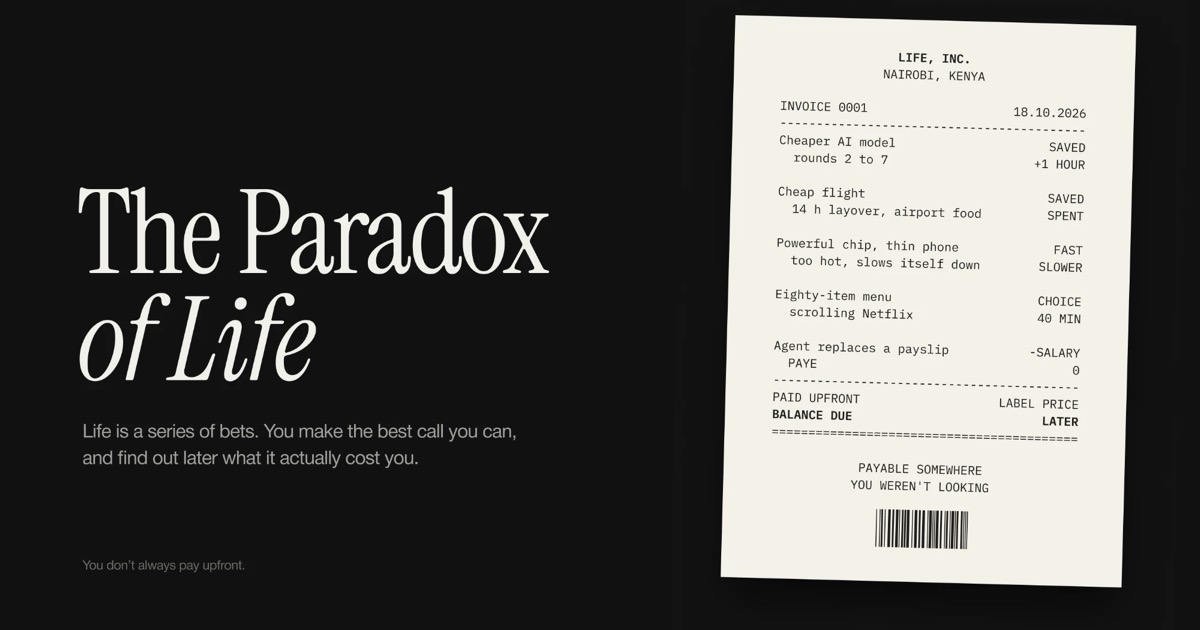
This started as a shower thought that just wouldn't leave. Almost every time I take the obvious route, life charges me for it later. The cheap option ends up expensive, the strong thing turns out fragile, the shortcut becomes the long way round. And once you start noticing it you kinda see it everywhere, lol.
Maybe life is just a series of bets. You bet on yourself, on other people, on the cheap option, on the shortcut. You make the best call you can with what you know at the time, and you find out later what it actually cost you.
So, lemme explain.
Buy Cheap, Buy Twice
If you use AI as much as I do, you've definitely had the token conversation with yourself. You want to save on tokens, so you switch to the cheaper model. Same prompt, fraction of the price, easy peasy, right?
Yeah, no. It gets most of the way there and then confidently gets the rest wrong. You correct it, it fixes that and breaks something else. You explain again, it apologises (very politely, every single time) and tries again. Seven rounds and an hour later you've spent more than you would have on one go with the expensive model, which probably would've just… done it. Once.
So the cheap model wasn't really cheap, it just charged me in retries and time and patience instead of money. The price on the label and the price you end up paying are two different numbers, and most of us only ever look at the first one. Me included.
Same thing with shoes that fall apart in six months, or the mechanic who's cheaper because he skips steps, or that "cheap" flight with a 14-hour layover where you end up spending the savings on airport food anyway, haha. Not always though, sometimes the expensive thing is just a logo with a markup. Knowing which one you're looking at before you pay is the hard part.
Too Powerful to Be Fast
I own an iPhone 15 and I love it, mostly. But every now and then, usually on a long call with the camera on and the Nairobi sun doing its thing, it gets hot. Like, uncomfortably hot.
I'm no engineer, but I'm assuming it's because there's a really powerful chip squeezed into something that fits in my palm. All that work turns into heat, and there's not a lot of phone for the heat to escape from.
And this is the funny part. When a phone gets too hot it protects itself by slowing the chip down. So the most powerful thing inside it is kinda the reason it ends up slower. A weaker chip would probably run cooler and feel more consistent on a hot afternoon, go figure.
We want our stuff powerful and small and thin, all at once, and physics keeps telling us to pick two.
(Side note: the iPhone Air doesn't get enough credit imo. Getting a phone that thin to not cook itself is seriously impressive engineering.)
Stronger While You Sleep
This one took me a while to get. When you lift weights you don't actually get stronger in the gym, that's just where you stress the muscle. The getting stronger happens when you rest, eat and sleep. The part that looks like doing nothing is where the growth is.
Ideas are like that for me too. My best ones almost never show up while I'm staring at the screen trying to force them. They show up in the shower, in traffic, at 2 AM when I should be asleep.
Forty Minutes on Netflix
You'd think more options would make choosing easier. Then you spend forty minutes scrolling Netflix and end up rewatching The Office. A menu with eighty items is somehow harder to order from than one with eight. Barry Schwartz has a name for it, the paradox of choice, which is basically a fancy way of saying freedom can feel like a chore.
Trying works the same way. The harder you try to fall asleep, the more awake you get. The harder someone tries to look cool, the less cool they look. And anyone who's sat in traffic (Nairobi, I'm looking at you) knows a shortcut stops being a shortcut the second everyone takes it.
Even learning does it. The more I learn, the more I realise how much I don't know. Beginners think they're nearly there, and the deeper you go the more you see you've barely started.
Who Pays When the Bot Works?
Every week there's another headline about AI replacing jobs: support agents, junior devs, copywriters, data entry. Is it happening as fast as people say? I genuinely don't know. And not every AI tool replaces a person, a lot of them just change what people spend their day on. But you can kinda see where it's heading.
For companies it looks great on paper. An agent doesn't need a salary, leave days or a pension. It doesn't get sick and it definitely doesn't ask for a raise.
But think about where the money goes next. In a lot of countries income tax is one of the biggest things keeping the government running. Here in Kenya it's PAYE, taken straight off your payslip before you even see it. When an agent fully takes over a salaried job, that payslip goes, and the tax goes with it. Sure, the company still pays for servers and electricity and software, so some money keeps moving. But the agent doesn't get paid, and it doesn't spend the way a person does. It's not buying lunch from the spot down the road.
Now picture that at scale, while the government still has roads, hospitals and schools to pay for. Where does it make up the difference? My guess is the people who still have jobs.
So what's the plan, tax the bots? Bill Gates suggested a "robot tax" back in 2017: if a robot takes your job, tax the robot roughly the way you were taxed. Sounds fair until you try to define it. What even counts as a bot? A chatbot? A script? A spreadsheet macro?? Do you tax it per agent, per task, per token? And where does it pay? The agent replacing a call-centre seat in Nairobi or Manila or Manchester could be running on a server in another country, owned by a company in a completely different one. So some of what used to be a local salary might just end up overseas.
That's the paradox for me. Agents are cheap partly because they don't pay tax. Tax them like workers and a lot of the savings go away. Don't tax them and, if enough jobs go, governments collect less, people have less to spend, and companies end up with fewer customers who can afford whatever they're selling. Henry Ford supposedly paid his workers enough to buy the cars they were building. A company that replaces its customers' jobs might end up replacing its customers too.
Grain of salt: I'm a designer, not an economist. None of this is guaranteed, I don't have the answer, and I'm not sure anyone does yet. I'd just rather we start asking now than in the middle of a crisis.
Where the Heat Goes
I don't think the lesson is "always pick the expensive option" or "never take the shortcut." Sometimes the cheap model is totally fine for the job, and sometimes the shortcut really is shorter.
But every one of these is a bet. The cheap model, the thin phone, skipping rest, adding one more option, swapping a person for an agent. Each one looks like a sure thing when you make the call, and only later do you find out what you actually got, and what it cost. So I'm trying to look past the price on the label for a second before I bet. What does this cost me later? Who ends up paying for it? Where does the heat go?
You don't always pay upfront. Sometimes the bill just shows up later, somewhere you weren't looking.